Boyeg Solutions innovation
The Boyeg Keyboard — advancing digital access through African languages.
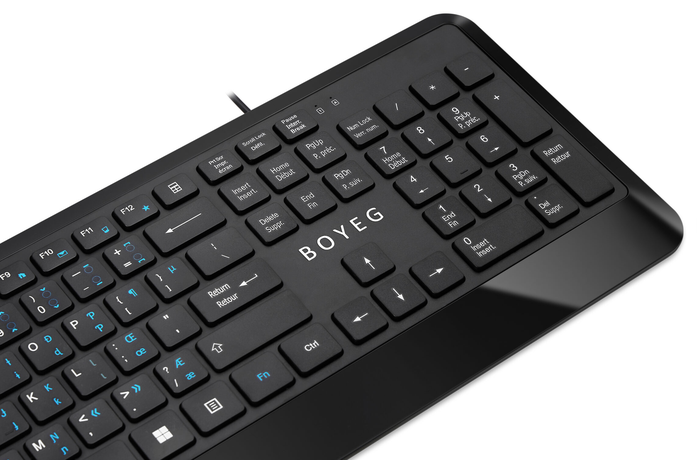
An African language technology product from Boyeg Solutions, designed to make digital communication more inclusive while helping keep the languages and cultural knowledge of African communities alive and usable.
The product
A multilingual keyboard experience
a multilingual experience centred on African languages, English and French. It exists so that people can type in the language they actually speak — at home, in the office and on their phone.
The product is designed as an everyday inclusion: usable at the desk in everyday work and carried into messaging on a phone. Language inclusion is the point — technology should adapt to the people using it, not the other way around.
The challenge
Digital tools have been built around a handful of languages.
Most keyboards, apps and systems assume a small number of globally dominant languages. Everything else arrives later, if it arrives at all.
Language limitations shape participation. When a person's first language cannot be typed easily, everyday digital work — messages, documents, schoolwork — happens in a second or third language, or not comfortably at all. That gap is quiet, but it accumulates: confidence drops, expression narrows, and people take part less across every tool that shares the same limitation.
What gets lost is not just convenience. A local language carries history, identity, culture and knowledge. It is the language people think in and the one that binds a community. When a language is absent from digital tools, its everyday use weakens, and the distance between generations grows.
How it helps
A practical contribution to inclusive digital participation
The Boyeg Keyboard makes multilingual typing straightforward. It supports African languages, English and French, so a person can work in their own language and switch between languages as the conversation requires — at the desk and on a phone.
That matters for representation as much as convenience. African languages become visible and usable in the digital environments where work and daily communication happen, without anyone having to argue for permission first.
Every message, document and conversation typed in an African language strengthens that language in exactly the places it matters day to day. That is the practical contribution: inclusion, not novelty.
Language inclusion
A broad range of African languages and language communities
Boyeg Keyboard is designed to support a broad range of African languages and language communities, with coverage that extends across many regions and linguistic traditions. The names below are a representative selection, not the full inventory.
Amharic
Efik
Ewe
Fante
Fila
Gwari
Hausa
Ibibio
Idoma
Igala
Igbo
Isoko
Jukun
Kanuri
Nupe
Swahili
Tangale
Tarok
Tiv
Urhobo
Yoruba
Zarma
Zulu
The product is presented as supporting 2,000+ languages and language communities, with users across 50+ African countries.
Digital preservation
Keeping African languages alive in the digital world
Technology supports language preservation where it counts: by making languages practical in the tools people use every day.
The Boyeg Keyboard contributes to digital language preservation by making African languages easier to use in everyday digital communication. When people can type in their own language, more of that language gets written down, shared and passed on — in messages, at work, in school and online.
This connects cultural identity with digital innovation, and keeps local languages visible and practical in modern technology.
One keyboard is not the whole answer. No single product preserves a language on its own — that work belongs to communities, schools and families. What the Boyeg Keyboard does is remove a systematic technical barrier, so the language can show up wherever digital tools already support the world's more dominant languages.
Capabilities
What it makes possible
Stated plainly, based on what the product is designed to do.
Multilingual typing
Support communication across African, English and French language contexts in one place.
African language inclusion
Make local languages more visible and usable in digital spaces — not as an exception, but as a standard input.
Cultural preservation
Help communities continue using their languages as digital communication evolves.
Broader digital participation
Reduce language barriers that can limit access to digital tools.
Scalable language support
Represent a wide range of African languages and language communities.
Broader impact
Language, technology and participation
Why this sits alongside our client work rather than apart from it.
Inclusive communication
People take part in digital life in the language they are most comfortable in, rather than working around a default.
Shared across the continent
One product, designed for users across many African countries — rather than a separate tool per community.
Language meets technology
Technology designed with African language communities in mind, rather than extended to them as an afterthought.
Everyday usefulness
Support for commonly used currency symbols and practical characters can make everyday digital communication more useful.
Learn more, or talk to us about language technology.
Full product detail lives on the Boyeg Keyboard site. For partnerships, deployments or bringing inclusive technology to your organisation, start a conversation with the team here.